


Role of copper in DME carbonylation to methyl acetate over mordenite-type zeolites: A combined experimental and DFT study
Shohei Tada, Keigo Komori, So Nishikawa, Ryota Osuga, Tetsuo Honma, Ryuji Kikuchi, and Tatsuya Joutsuka
Making the right bond: clarifying reaction mechanisms in zeolite catalysts through experiment and computational chemistry
Catalysis is often described as the “science of adsorption”: molecules attach to a catalyst surface, where they meet and react. Associate Professor Shohei Tada’s research into dimethyl ether carbonylation revealed a more nuanced picture. Combining experiments with computational chemistry, his team clarified how the crucial carbon–carbon bond forms during the reaction. The finding advances his longer-term goal of developing an end-to-end catalytic pathway from CO₂ and green hydrogen to sustainable ethanol.

Towards an end-to-end sustainable production of ethanol through catalysis
What we didn’t know for sure is that it attacks “from above,” says Associate Professor Shohei Tada, who recently presented his findings on the mechanism of the dimethyl ether carbonylation reaction over modernite-type zeolite. The moment when a carbon–carbon bond forms, a key step in converting DME to methyl acetate, is captured in a beautiful artistic representation of the reaction featured on the cover of the May 2026 issue of The Journal of Physical Chemistry C, published by the American Chemical Society.
Understanding this reaction for Tada is a critical step in the broader challenge of converting CO₂ and hydrogen into useful C2 oxygenates such as ethanol. As technologies for producing green hydrogen and capturing CO₂ from waste-biomass combustion advance, developing efficient pathways to convert these resources back into fuels becomes an important part of closing the carbon cycle and moving toward net-zero emissions.
The challenge of ethanol production through catalysis is not simply to form a carbon–carbon bond, but to form the right one selectively. “Although dimethyl ether carbonylation reaction itself has long been known, relatively little research has focused on its mechanism, partly because the unstable chemical species formed during the process are difficult to detect using conventional analytical methods,” explains Tada.
Tada and his colleagues decided to approach the problem from two directions. One team used computational chemistry to analyze the reactions occurring on the catalyst at the atomic level, while another did in situ measurements at SPring-8 to observe the zeolite catalyst under reaction conditions. “By combining independently performed computational and experimental approaches, we were able to reduce bias and significantly advance our understanding of the reaction mechanism,” says Tada.
“This is an important step toward end-to-end catalytic production of ethanol.” He adds with a smile, “Actually, the concept for the cover art was developed by my daughter. Family support makes this research even more worth pursuing for me.”
Product selectivity varies according to zeolite acid strength
Zeolites are porous materials widely used as catalysts, with molecular-scale channels that provide confined spaces for chemical reactions. Carbonylation over mordenite-type zeolite was first reported by Fujimoto and his team in 1982 and subsequently shown to catalyze carbonylation of methanol and DME. Copper-modified form of mordenite demonstrated particularly high performance, but the reason for copper’s effectiveness was not well understood.
“Why copper, and does it really have to be copper? That is what puzzled me,” says Tada. “Both the structure of zeolite and highly complex reaction pathways made it difficult to obtain excremental evidence of the copper’s role.”
Data obtained by his collaborator specializing in computational chemistry, Associate Professor Tatsuya Joutsuka of Ehime University called into question the idea that copper’s main role might be to activate CO. His analysis revealed that while dimethyl ether (CH3OCH3) adsorbs onto the mordenite-type zeolite, CO reacts directly with the dimethyl ether without adsorbing to the zeolite itself in the synthesis of methyl acetate (CH₃COOCH₃).
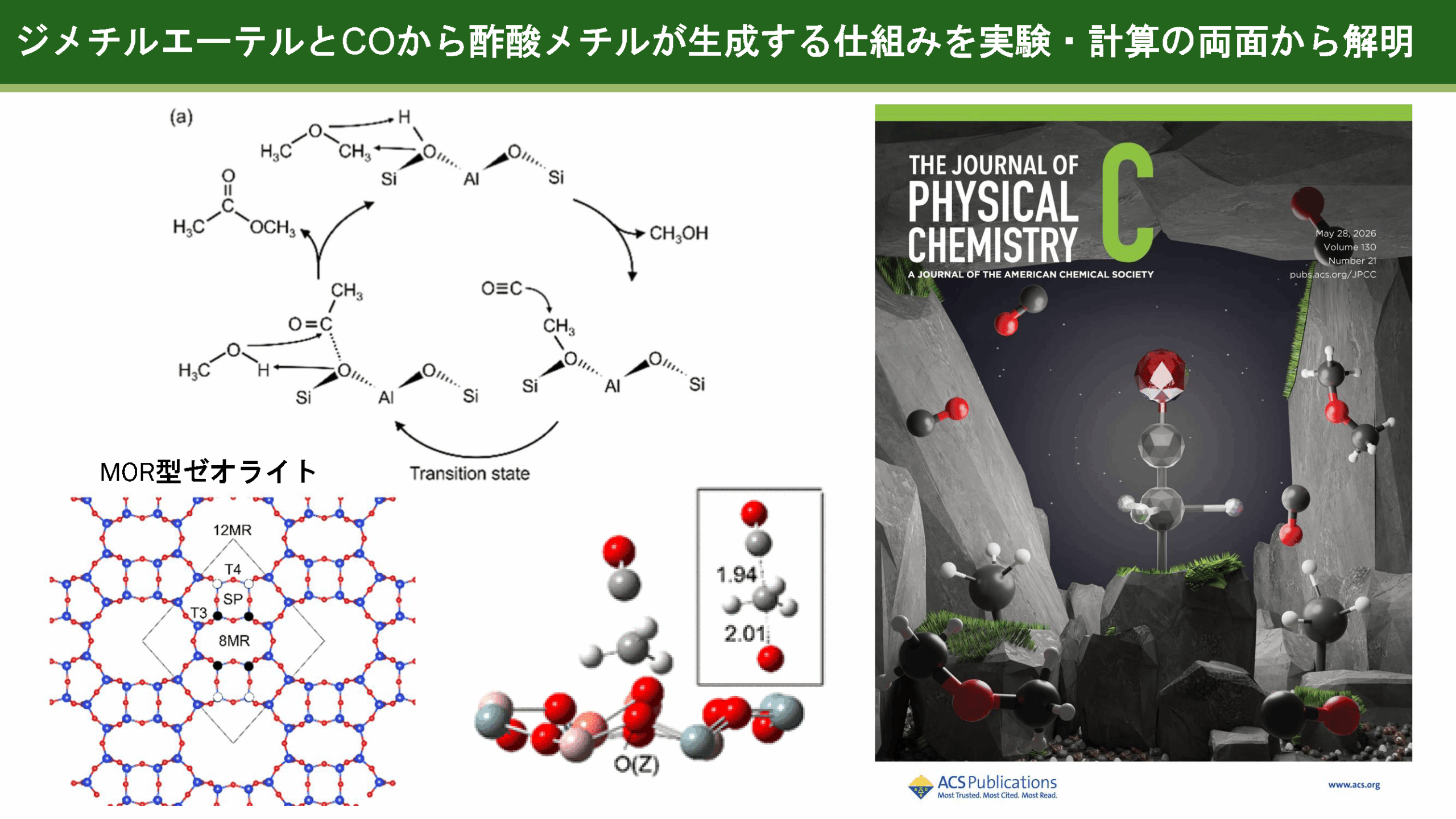
A closer look at experimental and computational data showed a different role of copper. If the acid sites in mordenite were too strong, the DME-to-olefin (DTO) reaction became dominant. If they were too weak, CH₃ groups instead reacted with each other, producing ethylene and ethane. “We found that copper indirectly improved selectivity by modifying the Brønsted acid sites in the zeolite and reducing the proportion of strong acid sites that promote competing reactions, creating conditions optimal for producing our target product, methyl acetate,” says Tada.
Understanding the reaction’s pathways has implications for catalyst design as well. “Let’s look at ‘why copper?’ question the other way around,” says Tada. “There are currently 265 zeolite framework types recognized by the International Zeolite Association, but only a small number are readily available commercially. Knowing how much we need to tune the acidity, we can determine how to modify the zeolite to achieve the best results.”
Working at the heart of catalysis research
For Tada, Hokkaido University offers one of the best environments for catalysis research in Japan, rivaled perhaps only by Tokyo.
The Institute for Catalysis at Hokkaido University is designated by MEXT as a Joint Usage/Research Center and serves as a major hub for catalysis research and collaboration in Japan, with connections extending around the world. Its history dates back to 1943, when the world’s first research institute dedicated to catalysis was established at Hokkaido University. It later became the birthplace of the Catalysis Society of Japan. This long history has helped foster a strong research community in the field.
“Hokkaido branch meetings are comparable to national conferences in the level of the presentations and discussions, and the students who take part are remarkably strong. I don’t think it is an exaggeration to call Hokkaido University the heart of catalysis research in Japan,” says Tada.
During his time at ETH Zürich in Switzerland, Tada saw researchers routinely working across multiple collaborative projects and came to appreciate what could be achieved by bringing together people with different expertise.
“Collaborative research requires you to accept what you don’t know and ask other people for help. That is how you build a powerful team, with each person contributing what they do best.”
For the present study, Tada invited Associate Professor Tatsuya Joutsuka, whom he had met while working at his previous institution. Joutsuka’s expertise in computational chemistry brought a fresh perspective to questions Tada had been approaching experimentally.
“Last year, we also started an international collaboration with researchers in Taiwan, and recently we submitted a paper together with an international student from India. Talking with people not only from other fields but also from different cultures is a valuable source of insight.”
Asked what message he would give to students, Tada says, “Many people seem to become uneasy when there is no clear answer. But the lack of answer is the site where real scientific battles happen. I want students to develop critical ability to formulate and defend their answers to the problem. It’s how my own research was made possible.”
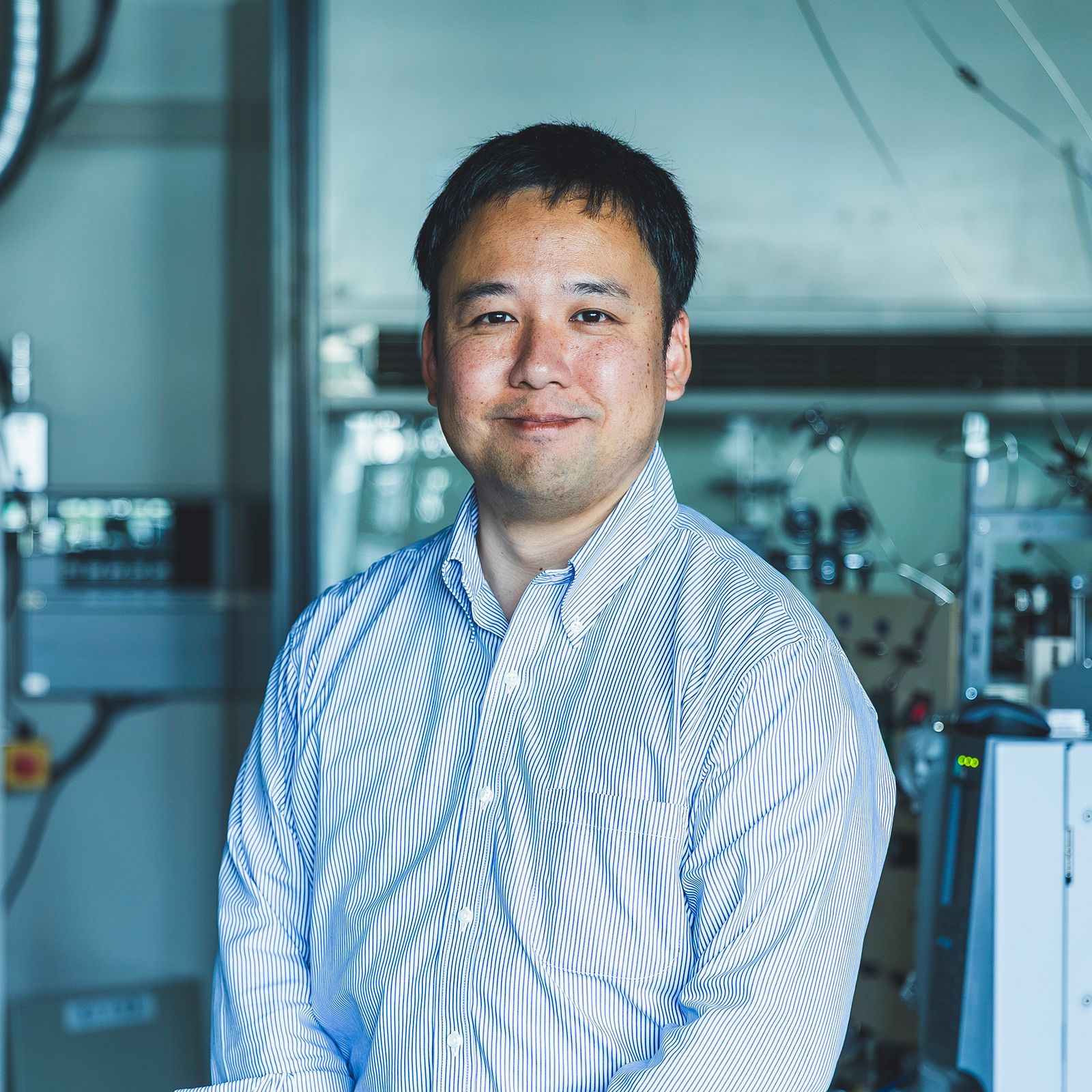
Shohei Tada
Associate Professor
Division of Applied Chemistry
Faculty of Engineering